
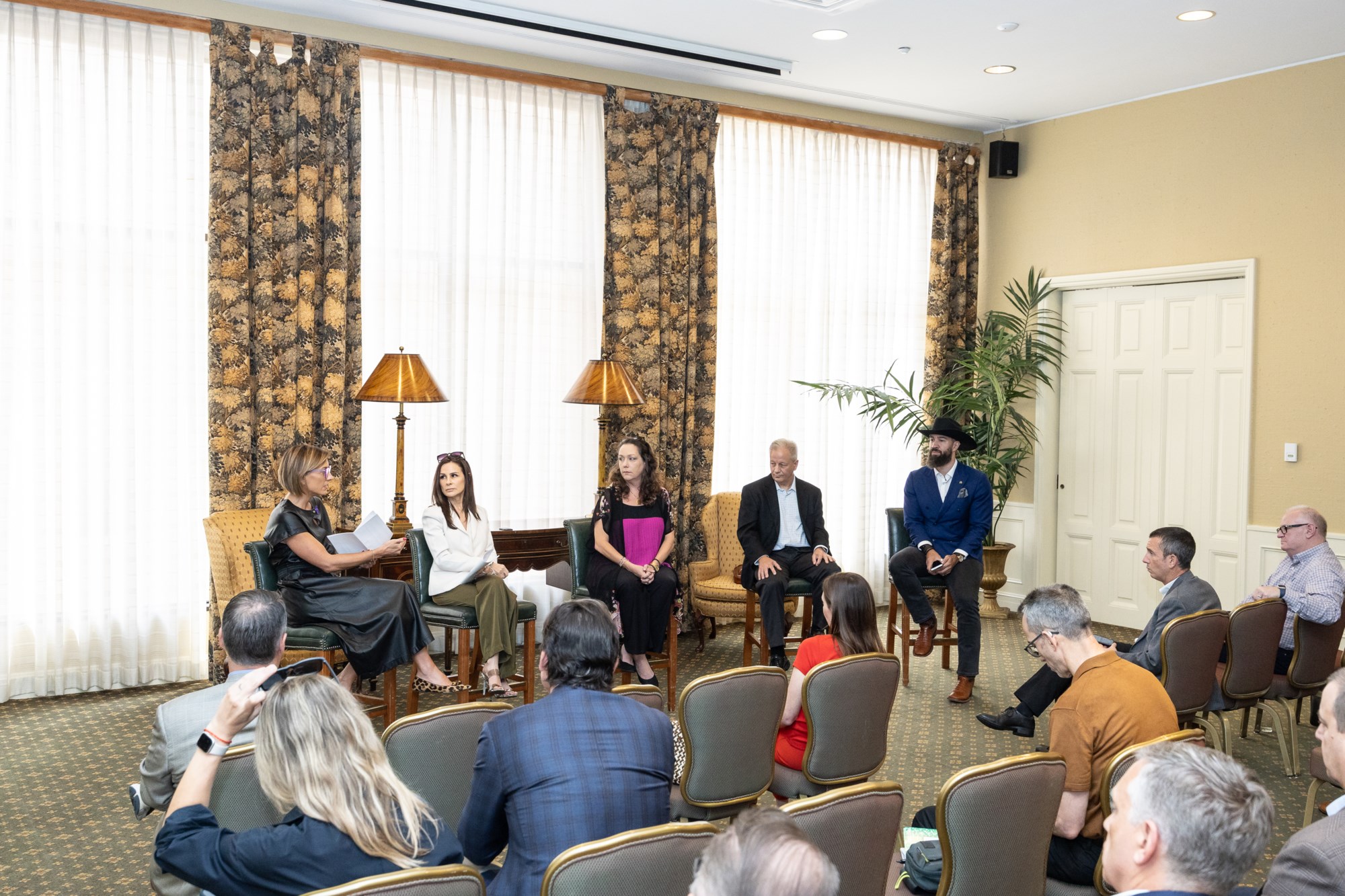
At the Critical Infrastructure Forum, the first panel focused on energy, space, and strategic infrastructure.
But the deeper conversation was not really about any one sector.
It was about coordination.
Energy, space, data centers, capital, regulation, workforce, public policy, and local communities are no longer separate conversations. They are increasingly part of the same system. The challenge is that many of the people responsible for building, financing, regulating, buying, and deploying that system are still operating in separate rooms.
That was the central insight from the discussion: critical infrastructure is no longer just a sector. It is a coordination problem.
Here are five key takeaways.
1. Infrastructure is expanding beyond physical assets.
Historically, when people heard “critical infrastructure,” they often thought about power plants, roads, utilities, transmission lines, water systems, buildings, or industrial assets.
Those still matter.
But the category is expanding.
Today, critical infrastructure also includes data, compute, cybersecurity, capital formation, supply chain resilience, advanced energy, space assets, public-sector procurement, and the systems that allow emerging technologies to move from innovation to deployment.
Joley Michaelson, Founder and CEO of The Sun Company, made the point clearly when discussing energy planning:
“Energy, water, land, economic development, those discussions are all had in separate rooms. And they need to come together.”

That may be the most important infrastructure challenge facing high-growth regions.
The issue is not only whether we can build more assets. It is whether we can coordinate the systems around those assets quickly enough to support demand.
2. Energy has become the enabling constraint.
Energy was one of the clearest themes of the panel.
Joley described energy as “the preeminent resource that enables all of society,” and argued that demand has outpaced planning in a way that will affect nearly every major industry.
That matters because energy is no longer just a utility conversation. It is now a growth conversation.
Data centers need power. Advanced manufacturing needs power. Space infrastructure needs power. AI needs power. Communities need reliable and affordable power. And the companies building the next generation of infrastructure need a modernized energy system underneath them.
Nikki Morris, Executive Director of the Ralph Lowe Energy Institute at TCU, reinforced that Texas and North Texas have already benefited enormously from energy-driven economic growth. But the next phase will require more than traditional strength in oil and gas.
It will require a broader, more coordinated energy strategy across natural gas, renewables, storage, nuclear, transmission, workforce, policy, and capital.
The energy opportunity is real.
So is the bottleneck.
3. The space economy is moving beyond launch.
One of the strongest insights from Meagan Crawford, Co-Founder and Managing Partner of SpaceFund, was that the space economy is no longer just about rockets.
She pointed out that launch costs have fallen dramatically, and that the more important question is no longer simply how we get things to space.
The bigger question is: what are we launching, and who is going to pay for the market around it?
As Meagan put it:
“Launch is a solved problem. The question I want you to all ask is what’s being launched?”
That changes the commercial conversation.
Satellites need customers. Space companies need insurance, debt financing, venture capital, facilities, testing, logistics, data storage, and a broader support ecosystem.
In other words, space is becoming a market with an entire capital stack and service economy around it.
That creates a major opportunity for Texas and DFW — not only because of launch activity, but because of the financial, advisory, real estate, infrastructure, and professional services capabilities required to support the industry.
4. Innovation needs translators, not just investors.
A recurring point across the discussion was that innovation alone is not enough.
Emerging infrastructure companies need capital, but they need the right kind of capital. They need customers, but they also need people who can help explain technical markets to commercial audiences.
Meagan described this as a translation problem:
“You have to find those bridges between capital markets and the startups themselves.”

Her point was simple: engineers and technical founders may understand the technology deeply, but they often struggle to communicate the commercial opportunity in a way capital markets understand.
That problem is not limited to space.
It shows up across energy, nuclear, storage, data centers, cybersecurity, defense, and other infrastructure-adjacent sectors. The builders, buyers, investors, policymakers, and advisors often speak different languages.
If those groups cannot understand each other, promising companies can stall before they ever reach deployment.
The opportunity is not just to fund innovation.
It is to translate it.
5. DFW has the ingredients, but the coordination layer is still being built.
The panel repeatedly came back to Texas’ advantages.
The state has energy expertise, space activity, industrial capacity, financial strength, population growth, real estate, and a business environment that attracts companies and capital.
DFW adds another layer: corporate headquarters, financial services, logistics, advisory firms, investors, professional services, and access to a broad middle-market operating base.
But having the ingredients is not the same as having a coordinated market.
Dan Garretson, Managing Partner of CounterFlow Solutions, pointed to the need to bring “the operators, the capital providers, the policymakers” into the same room to smooth the path between innovation and deployment.
That may be the real opportunity for DFW.
The region does not need to copy Silicon Valley, Houston, Austin, or Florida. It needs to become better at connecting its own assets.
Energy leaders need to be in the room with data center developers. Space companies need to be in the room with capital providers. Technical founders need to be in the room with customers. Policymakers need to hear from operators. Advisors need to understand where the bottlenecks are forming.
The next decade of growth will not be won only by the regions with the most activity.
It will be won by the regions that coordinate activity best.
That was the deeper message from CIF’s first panel.
Critical infrastructure is no longer sitting off to the side of the economy.
It is becoming the operating system beneath it.
And right now, one of the biggest opportunities is not simply to build more.
It is to connect better.


Leave a Reply