
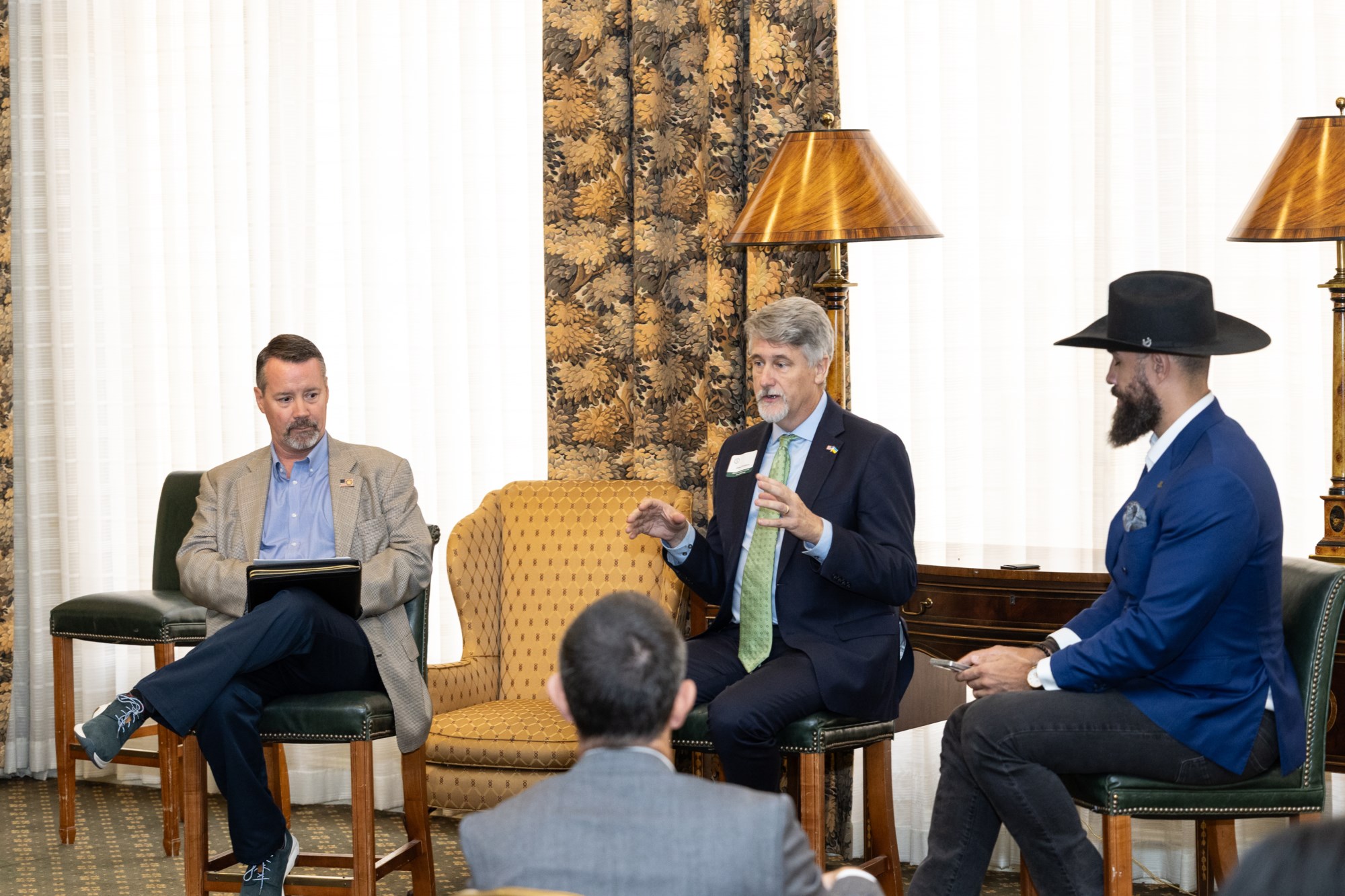
At the Critical Infrastructure Forum, the second panel focused on security, capital, and commercialization.
But one of the most important themes was not just about defense innovation at the highest level.
It was about the middle.
The fragmented middle.
Across DFW and Texas, there are manufacturers, operators, suppliers, service providers, investors, defense-adjacent companies, and technical businesses that sit between large primes and early-stage startups. Many of them are not headline-grabbing companies. They may not look like venture-backed software businesses. They may not be obvious “frontier tech” companies.
But they may be central to the next phase of defense-industrial growth.
The panel made clear that DFW’s opportunity is not simply to become another Silicon Valley, another Austin, or another coastal defense innovation hub.
DFW’s opportunity may be to organize, upgrade, connect, and scale the companies already sitting inside the region’s industrial base.
Here are seven key takeaways.
1. DFW’s advantage is not one thing. It is the combination.
Andrew Finn, Operating Partner at Appian Way Capital, described DFW and Texas as having several important ingredients: an installed base, customers, manufacturing capacity, cost structure, workforce, and timing.
That combination matters.
Defense-industrial growth does not happen because a region has one attractive asset. It happens when customer demand, operating companies, manufacturing capability, capital, talent, logistics, and cost structure begin to reinforce one another.
DFW has many of those ingredients.
The question is whether they can be coordinated quickly enough.
2. Customer demand is already close to home.
One of the strongest points from the panel was that Texas already has significant defense and military demand nearby.
Andrew described the presence of military installations and related demand as “customer demand.”

That is important because one of the biggest challenges for emerging defense and infrastructure companies is not only building the product. It is getting close enough to real customer problems.
DFW and Texas do not have to invent demand from scratch.
They need better pathways between operators, manufacturers, suppliers, defense customers, primes, capital providers, and policy leaders.
The opportunity is not just to attract companies.
It is to help existing and emerging companies get closer to the customers that matter.
3. The manufacturing base is real, but fragmented.
The panel repeatedly returned to fragmentation.
Andrew pointed to a base of small manufacturing businesses across DFW and Texas, many of which are individually too small to pursue larger opportunities, invest in compliance, or scale into major programs.
That fragmentation is both a weakness and an opportunity.
On one hand, fragmented companies often lack the capital, systems, certifications, management depth, and customer access needed to compete for larger contracts.
On the other hand, fragmentation creates room for consolidation, partnership, platform-building, and investment.
As Andrew put it, the opportunity is to create “a consolidated base of companies” that can pursue larger work than any individual company could pursue alone.
That is the hidden middle-market opportunity.
Not just one company winning a contract.
A stronger regional supplier base becoming more competitive.
4. Compliance may become the dividing line.
Defense-industrial opportunity is not just about capacity. It is also about readiness.
Cybersecurity, CMMC, documentation, quality systems, procurement requirements, and customer risk expectations are becoming commercial gatekeepers.
For many small and mid-sized companies, that is a difficult hurdle. The cost is real. The expertise is specialized. The process can feel intimidating. And for founder-led or lifestyle businesses, the investment may not feel immediately urgent.
But the panel made clear that larger customers and tier-one suppliers are unlikely to carry unnecessary risk if other suppliers are better prepared.
That means compliance can become a dividing line between companies that participate in the next phase of defense-industrial growth and companies that get left behind.
The opportunity for DFW is to help more of its middle-market companies cross that line.
5. Private capital can upgrade the middle.
Private capital was another major theme.
Andrew described private equity as a potential catalyst when used properly: consolidating fragmented companies, injecting capital, building compliance, improving systems, and creating stronger operating platforms.
That is a compelling opportunity in DFW because many of the relevant businesses may not need to become venture-backed companies.
They may need modernization, systems, succession planning, certification, stronger management, customer access, and a capital partner who understands the defense-industrial opportunity.
In that sense, the defense opportunity in DFW may not be only about funding startups.
It may be about upgrading existing companies.
The middle-market operator, manufacturer, and supplier base could become more strategically valuable if it receives the right capital, compliance support, leadership, and customer connectivity.
6. Timing matters because other markets have already moved.
Andrew also made a timing point: other markets have already seen consolidation.
That matters because once private capital begins moving aggressively into a fragmented market, the window can change quickly. Multiples rise. competition increases. high-quality targets become harder to find. And the best opportunities may disappear before local stakeholders fully understand what is happening.
DFW may still have a window.
But windows do not stay open forever.
If the region wants to become a more serious defense-industrial hub, the next 18 to 36 months may matter.
The companies, investors, advisors, economic developers, and policy leaders who understand the opportunity early may be better positioned than those who wait until the market is already crowded.
7. DFW needs a stronger point of view.
Drew Scheberle, Executive Director of the National Security Innovation Council, made one of the most important regional points:
“Texas really needs to have an opinion.”
That line captures a deeper issue.

It is not enough for Texas to have assets. It is not enough for DFW to have companies, capital, and customers. The region also needs a point of view on where defense, national security, manufacturing, autonomy, cybersecurity, supply chain resilience, and infrastructure are going.
That point of view matters because acquisition, procurement, policy, capital, and customer relationships are shaped by trust, expertise, and repeated engagement.
DFW cannot simply wait for federal customers, primes, and investors to define the opportunity for it.
The region needs to help define the opportunity itself.
That means bringing the right people into the same room: operators, manufacturers, capital providers, defense leaders, policy stakeholders, economic developers, advisors, and commercial customers.
That was the deeper message from the second panel.
DFW’s defense opportunity may not be hiding in a single breakthrough technology or a single large company.
It may be hiding in the fragmented middle — the companies already building, supplying, manufacturing, operating, and adapting across the region.
The opportunity is to organize them.
Upgrade them.
Connect them.
And help them compete at a larger scale.
Leave a Reply