

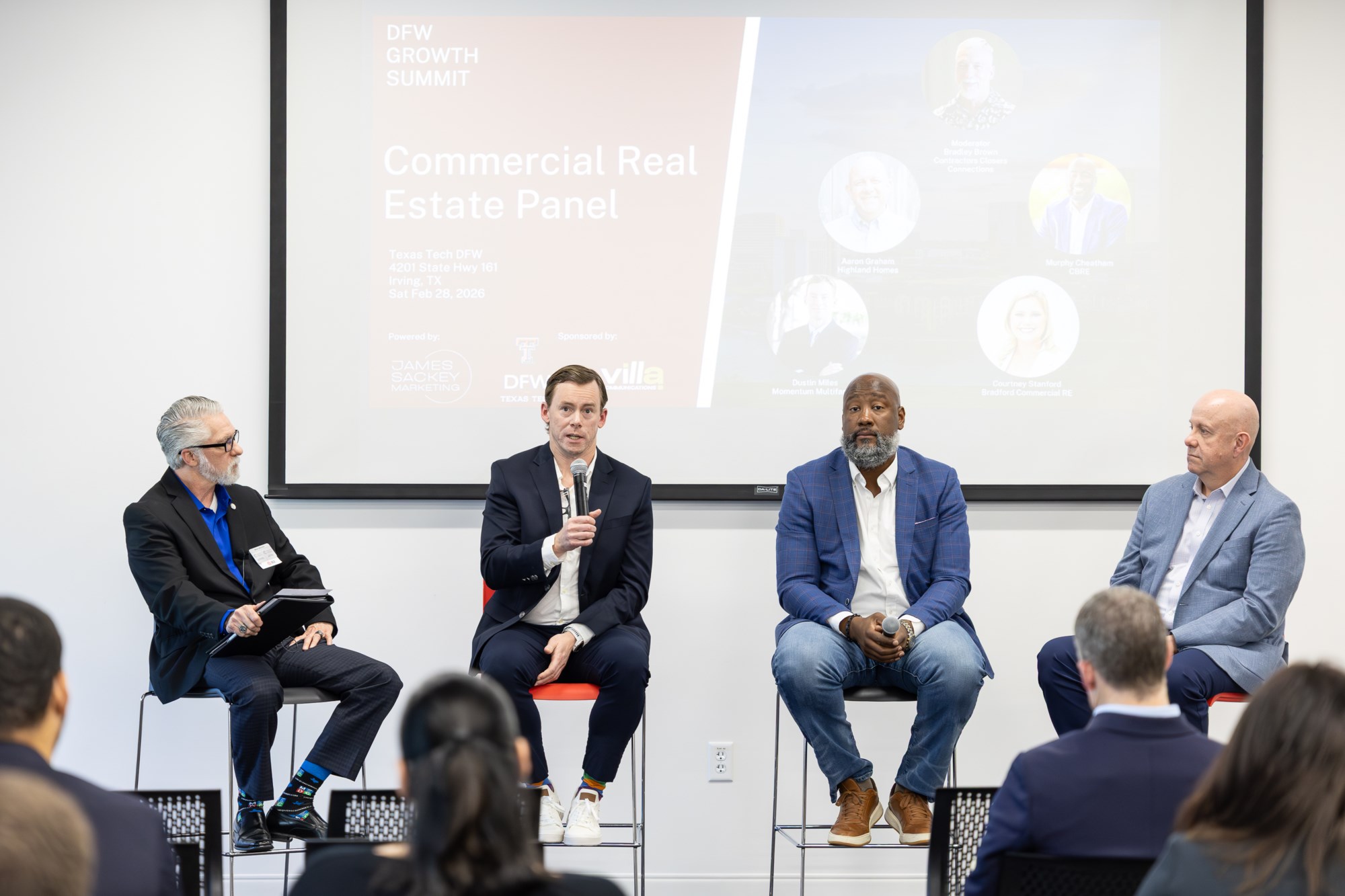
Long-Term Signals Beneath Short-Term Volatility from the 2026 DFW Growth Summit CRE Panel
If you only read the headlines, you’d think commercial real estate in Dallas–Fort Worth is under siege.
Multifamily distress. Office vacancies. Refinancing pressure. Slower deal flow.
And yet — when you zoom out — the panel discussion at the 2026 DFW Growth Summit painted a very different long-term picture
The short-term cycle is real. But so is the structural upside.
Here’s why DFW remains one of the most compelling markets in the country.
1. The Population Math Is Relentless
“We’re just over 8 million in DFW today. We’re going to 12 million by 2050. Where are all those people going to live?” — Aaron Graham
That’s nearly 4 million additional residents in roughly two decades.
Put differently: the region is absorbing the equivalent of one to two “Waco’s” per year in net population growth
You can debate timing.
You can debate interest rates.
You cannot debate demographic gravity.
Housing, retail, infrastructure, logistics, healthcare, education, professional services — all of it expands with rooftops.
And rooftops are coming.
2. Today’s Oversupply Is Tomorrow’s Undersupply
Yes, multifamily is under pressure. Distress is elevated. A large portion of transactions today are lender-controlled or foreclosure-related
But here’s the key nuance:
- Multifamily construction has slowed dramatically.
- Builders are already moderating new starts.
- Long-term housing production in Texas has lagged population growth since the Great Financial Crisis
When demand continues climbing but supply pulls back, the imbalance flips.
The current environment may feel saturated in pockets. Structurally, DFW is still behind where it needs to be to house its future population.
That’s not bearish. That’s cyclical.
3. Interest Rates Have Reset — Not Collapsed the Market
One of the most grounded insights from the panel: interest rates today are closer to historical norms.
“Interest rates are where they should be. The cheap money years were the anomaly.” — Murphy Cheatham

Cheap debt in 2021–2022 was the anomaly.
The repricing of capital has forced discipline:
- Lower leverage
- More realistic underwriting
- Higher equity requirements
- Stronger sponsor scrutiny
That’s painful for over-levered players.
It’s healthy for the market long-term.
Capital cycles cleanse excess. DFW’s fundamentals remain intact.
4. Commercial Real Estate Is Now Hyper-Localized
Perhaps the most strategic insight: broad narratives are misleading.
Downtown Dallas vacancy may hover in the 25–35% range, while Uptown is closer to low single digits
Same city. Radically different outcomes.
Why?
- Proximity to amenities
- Experience-driven office environments
- Walkability
- Retail integration
- Talent clustering
- Migration of corporate headquarters
This is not a “CRE is dead” story.
It’s a micro-market selection story.
Like the 121/Tollway corridor. Alliance. Mansfield. Collin County. Uptown. Select Fort Worth submarkets.
Capital is not fleeing DFW. It’s concentrating.
That’s a sign of maturation, not decline.
5. Experience Is the New Currency of Office
Remote work didn’t kill office. It changed the bar.
If an office building cannot offer:
- Lifestyle integration
- Retail activation
- Food, fitness, and amenities
- Talent density
- Brand positioning
…then it struggles.
If it does?
It leases.
The “flight to experience” isn’t theoretical. It’s showing up in vacancy data across submarkets
DFW has the advantage of land, capital, and development capacity to reconfigure assets toward this model.
That’s bullish for adaptive owners.
6. Industrial Is Quietly Dominant
While headlines fixate on office, industrial continues to perform.
E-commerce logistics. Distribution. Fulfillment. Flex space. Hybrid industrial-retail concepts
Industrial may not be glamorous, but it is structurally tied to:
- Population growth
- Consumer demand
- On-demand delivery
- Supply chain reshoring
And DFW is a logistics hub.
When 4 million more people arrive, goods must move.
Industrial benefits.
7. Retail Still Follows Rooftops
This is an old principle — but it remains true.
As residential growth pushes north and outward, so does:
- Grocery
- Medical
- Fitness
- Dining
- Service businesses
DFW’s outward growth pattern ensures continued retail development in emerging corridors.
It’s not about malls. It’s about neighborhood ecosystems.
8. The $7–12 Trillion Wealth Transfer Is a Catalyst
One of the most overlooked macro forces discussed: the coming intergenerational wealth transfer.
“This is the largest intergenerational wealth transfer in human history — and it’s happening right now.” — Aaron Graham
Texas alone is expected to see trillions in wealth move from Baby Boomers to Gen X and Millennials over the next two decades
What happens to that capital?
- Some will recapitalize businesses.
- Some will seed startups.
- Some will flow into commercial real estate.
- Some will fund private investments and entrepreneurship.
Regardless of allocation, liquidity increases.
Liquidity fuels activity.
Activity fuels regional growth.
DFW — already a magnet for corporate relocations and private capital — stands to benefit disproportionately.
9. Migration + Corporate Headquarters Density
Dallas ranks near the top nationally in corporate headquarters concentration
Major employers continue repositioning within the metroplex — often migrating toward amenitized, talent-dense corridors.
That corporate presence:
- Drives white-collar migration
- Drives housing demand
- Drives Class A office absorption in the right submarkets
- Drives retail and service ecosystems
DFW is not shrinking in relevance. It’s rebalancing internally.
10. Cycles Create Entry Points
Multifamily distress. Cash-in refinances. Bridge loan maturities. Equity wipeouts
Those are real.
But so are discounted acquisitions, stronger basis resets, and recap opportunities for disciplined capital.
Every downturn localizes, concentrates, and sharpens markets.
DFW’s cycle today is less about existential risk and more about:
- Balance sheet strength
- Submarket selection
- Duration strategy
- Capital structure discipline
The investors who underwrite demographics instead of headlines will likely look back at this period as a strategic entry window.
The Strategic Takeaway for Operators, Investors, and Advisors
DFW is not immune to cycles.
But its:
- Population trajectory
- Corporate density
- Logistics advantage
- Wealth transfer inflow
- Land availability
- Entrepreneurial ecosystem
…create structural tailwinds that overwhelm short-term volatility.
The cycle may feel choppy.
The trajectory remains upward.
If you zoom out far enough, DFW is still bullish.
And for disciplined capital and strategic operators, that distinction matters.
Leave a Reply